“The trust of the innocent is the liar’s most useful tool.”
Stephen King
During that period, the notorious Cold War “McCarthy” hearings were held by the U. S. Senate in 1954 into possible communist infiltration. Concurrently, the U.S. House held lesser-known ”Reece Committee” hearings.
They investigated possible subversion of the country by wealthy foundations, including the Carnegie Foundation, chartered to encourage, uphold and dignify the profession of the teacher and the cause of higher education; the Rockefeller Foundation, chartered to alleviate human suffering worldwide; and the Ford Foundation, chartered for scientific, education and charitable purposes.
Ford Foundation president Horace Gaither stunned head Reece Committee investigator Norman Dodd by admitting, “We shall use our grant-making power so as to alter life in the United States, that it can be comfortably merged with the Soviet Union.”
Ford Foundation president Horace Gaither stunned head Reece Committee investigator Norman Dodd by admitting, “We shall use our grant-making power so as to alter life in the United States, that it can be comfortably merged with the Soviet Union.”
Carnegie Foundation had already begun planning to “alter the life of an entire people” by involving the U.S. in war and taking control of how history was taught. The Rockefeller Foundation had supported zoologist Alfred Kinsey in altering the nuclear family through phony sex studies. What else were these monied giants doing?
The Diagnostic and Statistical Manual (DSM), the psychiatrists’ “bible,” was first published in 1952 and grew exponentially in every new iteration. Symptoms of trauma were called diseases with long names. There was a diagnostic code for multiple personality disorder, later called dissociative identity disorder.
The DSM mostly describes symptoms rather than the root causes of those symptoms. By treating symptoms instead of root causes, there was a chance for the medical profession to mask the origins of the problem. Thus, women who were depressed or children who were anxious would be medicated instead of asked about why they were depressed or anxious.
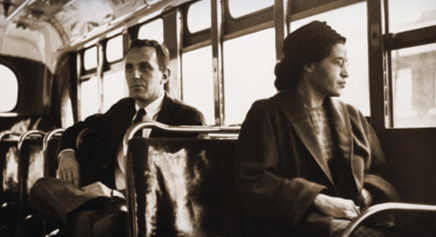
By 1957, the United States Commission on Civil Rights was founded two years after a small black woman named Rosa Parks refused to give up her seat to a white person in the front of a Montgomery Alabama bus in defiance of Jim Crow laws.
Oppressed children were given a boost in 1959 when the United Nations adopted an expanded Declaration of the Rights of the Child, increasing it to ten principles.
The United States still did not ratify it. Children were considered property, not people.
The advent of the Pill in 1960 gave women freedom from unwanted pregnancy. Former social constraints regarding sexual behavior were falling away. They continued to find more freedom as they entered the workforce in growing numbers and had their own incomes. As financial dependency decreased and sexual freedom increased, marriages began breaking down. With more economic resources, women found that leaving abusers was possible.
Oppressed women were finding help. Along with the rising social consciousness fueling the civil rights, anti-war, black liberation, and feminist movements, a grassroots battered women movement sprang up in the 1960’s as women increasingly fled violence in the home. AlAnon, the 12-step group for family members of alcoholics supported the movement. Despite social disapproval, divorce became increasingly popular.
It was not easy. Mostly acculturated to be subservient and obedient to men in general during that era, battered women found leaving their once-beloved spouse difficult. Trauma made it hard to plan an escape.
And there was another reason, more visceral and deadly, that made leaving an abuser hard. Instinctively, women knew it was dangerous to go. Those little hairs on the back of our necks evolved from prey animals that sense predators’ lethality.

Research provides statistics that are hard to stomach. Violence is estimated to occur in up to two-thirds of marriages. 85% of victims are women, who are 500 times more at risk when they leave and 70 times more likely to be killed within two weeks after leaving than any other time. These homicides could be prevented if women knew that some abusers are more lethal than others.
There are angry violent abusers, then there are cruel, sadistic abusers who enjoy exercising extreme control over “their” women. When they see their formerly obedient “property” walking out the door, they act accordingly, quickly, like a cobra striking.
In 1961, right after the start of the trial of German Nazi war criminal Adolf Eichmann, Yale University psychologist Stanley Milgram began his experiment to demonstrate a normal person’s blind obedience to authority. A very high number of male and female participants “just followed orders” and even administered what they were told were lethal electric shocks to a “learner” (an actor) when instructed by an authority figure.
Being obedient and submissive to an authority figure seems to be an ingrained quality in humans, like pack animals’ obedience to an alpha leader. Violence and threats are not even needed to create blind obedience.
Most situations are not as dramatic as the Milgram experiment, as most are not focused on life threatening decisions. However, severe domestic violence, which mostly affects women, is an exception. The victim may become even more obedient and passive from the fear and mistreatment, even if they do not realize that leaving is a dangerous time.
Domestic violence advocates have often walked that long walk to freedom and recognize the courage it takes to leave. They can be powerful allies for current victims to recognize lethality and develop exit and safety plans.
Batterers and molesters were not pleased at the increases in women’s freedom. Their world was turning upside down, in their minds. As kings of the castle, they believed their vassals should stay put, no matter what. As women and children escaped, abusers found themselves vulnerable to the possibility of prosecution, or at least a loss of reputation, for doing what used to be legal behind closed doors. Plus, they were having to pay child support.
Abusive men knew they had to do something, as more and more women began to leave them. To minimize spousal and child support obligations, they began bargaining assets in exchange for custody, literally banking on mothers’ love for their children in exchange for dropping requests for support.
Soon “conciliation” became the new buzz word for settling custody disputes outside of court. It worked for some separating couples but was a coverup of crimes for many.
The Men’s Rights Movement began as a backlash to these growing protections of women and children. The United States Divorce Reform was founded in Sacramento in 1961.
Judges and attorneys came together to move family conciliation and mediation into the mainstream. Cases with domestic violence and child abuse were called “high conflict cases” rather than criminal cases.
Protective grandfather Marv Bryer later spelled out how the AFCC helped to harm children with a focus and training on conciliation in Court Cancer Metastasizes: Metamorphosis of the Conference of Conciliation Courts into the Association of Family Conciliation Courts, A Guide to Destroying Children.
Crimes against women and children became muted, muffled, an expression of “pathology“ instead of their partner’s violent criminal acts. The same acts against a neighbor would, of course, be prosecuted to the full extent of the law.