“Take all the robes of all the good judges that have ever lived on the face of the earth, and they would not be large enough to cover the iniquity of one corrupt judge.”
In 2000, Sacramento Judge Peter McBrien was placed on probation for committing a felony that was reduced to a misdemeanor. He had repeatedly placed Josie Cohen’s son with his accused child rapist father but cutting that little boy’s life off at the knees did not feature in his discipline. This time, judge had gotten someone to cut down trees on a nature preserve so he would have a better view from his house.
Articles were written by R. V. Scheide in the Sacramento New and Review, including:
- Local judge under investigation: Alleged misconduct of Judge Peter J. McBrien is subject of Judicial Performance Commission inquiry. (1/02/08)
- Sacramento judge denies ‘disgracing the American Judiciary System,’ The strange and bewildering case of Judge Peter J. ‘Chainsaw’ McBrien (3/06/08)
- Out on a limb: A comedy of errors, starring Sacramento Superior Court Judge Peter J. McBrien (9/10/09)
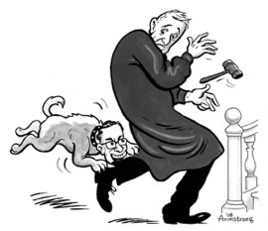
Judge McBrien was publicly admonished by the Commission on Judicial Performance (CJP) two years later. We thought for sure pleading down a criminal felony would lead to his removal from office. We were again so wrong.
He was back in the saddle with renewed hubris. He subsequently walked out in the middle of litigant Ulf Carlssen’s custody trial in 2006, and engineered Ulf’s dismissal from his state manager job. The attorney for the other side was Charlotte Keeley, who had been Josie’s son’s attorney and helped keep him with his pedophile father. Ulf and I filed a recall petition against the judge, but as volunteers with few resources, could not manage to gather enough signatures.
We did, however, encourage residents, including those who were standing in line to enter the Sacramento family courthouse, to send complaints to the Commission on Judicial Performance (CJP) about Ulf’s outrageous case.
We made copies of a complaint form, mentioning both Ulf and Josie’s cases. All the person had to do was to write their name. We even had stamped, addressed envelopes.
Over 100 people sent letters, which encouraged the CJP to look into the matter. They held a three-day hearing in April 2009, complete with a parade of character witnesses for Judge McBrien. These witnesses included attorney Camille Hemmer and Judge James Mize. Third District Appellate Court Justice Arthur Scotland also testified, saying that Judge McBrien had very few reversals on appeal. We knew that. Besides, most victims ran out of money for an attorney long before they could appeal a ruling.
Judge McBrien was not removed from office that day either.
Instead, he received a second discipline, a “severe public censure” in 2010 for repeatedly threatening Ulf and his attorney with a mistrial, notifying his employer, and ending the trial before Ulf completed his case. The judge was scrutinized by official-looking men in suits sitting in his courtroom for some time. He eventually retired in 2014 and was immediately hired back as a Sacramento Court employee, a commissioner, by then Family Court Supervising Judge James Mize.
The National Institute of Justice found that men were more likely to kill an intimate partner if they:
- Were violently, constantly jealous.
- Threatened to kill.
- Controlled of most/all daily activities.
- Used illicit drugs.
- Tried to choke/strangle the victim.
- Forced sex.
- Increased frequency/severity of physical abuse.
- Were violent outside the home.
- Used/threatened with a weapon.
- Had a gun in the house.
- Were believed by the victim to be capable of killing.
In 2000, the American Bar Association Family Law Section held an international conference titled High-Conflict Custody Cases: Reforming the System for Children, known as the “Wingspread Conference.” They produced an action plan. The ABA predictably recommended appointing attorneys for children.
The title of the conference and report’s Preamble gave away their bias.
“Children caught in the middle of high-conflict cases face perpetual emotional turmoil. They may become alienated from a parent or be harmed by exposure to domestic violence.”
First, these family law cases were not “high conflict” cases. These were cases of violence and sexual abuse, where one parent was trying to protect the child. Next, any report starting with “alienated” is a clear “red flag.” Finally, attorneys for children, also known as minors’ attorneys or “guardians ad litem” were supposed to be a neutral voice for the child to consider what is in the best interests of the child. However, they would often not even talk to their young clients, much less pay any attention to their interests, best or worst.
The parents would usually be ordered to pay the child’s attorney directly, whether they wanted one or not. If the self-represented victim had no money, the batterers would pay. Not surprisingly, attorneys for children nearly always aligned with the person paying them, making the situation far worse for the children. At one mother’s hearing, she sat alone at a table with piles of court documents. Her former husband sat at the other table, surrounded by his attorney, the children’s attorney and the evaluator, all crowded around him like courtiers.
We were educating people. The exposure caused a few judges to retire early, but the systemic problem persisted. The court-appointees were still doing major damage, giving risky recommendations which even good and fair judges followed because psychologists were considered experts. Not only was this a probably improper delegation of judicial authority, but these experts seemed clueless about the risk of lethality.
Activist attorney Patricia Barry filed a federal civil rights lawsuit on behalf of four mothers. It was turned down.
By 2000, SB 1944 (Solis) required California law enforcement officers investigating a domestic violence scene to identify the “dominant aggressor” instead of the former language of “primary aggressor” to counteract their practice of dual arrests for “mutual combat” (often between a small frightened woman and a large angry man.) This was a big leap forward. Law enforcement was rather noncommittal on these issues and certainly ducked the lead on domestic violence crimes.
But why?
SB 1944 (Solis) required California law enforcement Officers investigating a domestic violence scene to identify the “dominant aggressor” instead of the former language of “primary aggressor” to counteract their practice of dual arrests for “mutual combat.”
Intimate partner violence (IPV) is common. More than 1 in 3 women and more than 1 in 6 men experienced contact physical violence, sexual violence, and/or stalking by an intimate partner during their lifetimes. The cost of IPV over a victim’s lifetime was $103,767 for women and $23,414 for men.
| Type of violence | Women | Men | Total female + male victims |
| Physical violence | 22.5% | 13.7% | About 97 million victims |
| Contact sexual violence | 19.7% | 4.4% | About 65 million victims |
| Stalking | 12.2% | 4.2% | About 44 million victims |
That means there are arguably a similar number (or slightly less for serial offenders) of violent batterers roaming our communities. The odds of finding one as your next-door-neighbor, or in your bed, or at your door when you call 911, is high.
Law enforcement is an occupation that attracts people comfortable with violence, both stopping it and dishing it out as part of their job description. Their profession is all about control and draws people who accept violence as part of their job. Many take their job home with them.
Two studies showed that 28%-40% of officers were domestic violence perpetrators themselves. So, it stands to reason that some officers responding to domestic violence calls are perpetrators themselves and would be understandably resistant to investigating this particular type of crime. They might just turn a blind eye.

We contacted the California Attorney General’s office. We found out that they represent state officials accused of crimes, like judges. They were not a source of help.
Victims had to lead this battle charge. It was just incredibly pathetic. Our efforts so far were long on words, but short on effective action.
So, we decided to put together a California Judicial Investigative Task Force in 2000. We sent photos of Judge McBrien and a few other judges who consistently placed children at risk, along with a list of the cronies who helped them, to all California judges. We basically called out the local county cabals.
This caused quite a stir for a while. Something happened from our efforts. It wasn’t positive. An advocate helping with the project was investigated and threatened by law enforcement.