“If you can’t fly then run, if you can’t run then walk, if you can’t walk then crawl, but whatever you do you have to keep moving forward.”
Martin Luther King Jr.
Oppressed increased in the new twentieth century. During the early 1900’s, the Carnegie Institution, Rockefeller Foundation and other large foundations began funding the American eugenics movement which began seeking solutions to the “unfit.”
The Carnegie Foundation for the Advancement of Teaching began operations in 1905. It was later learned that their first meeting minutes documented that the trustees asked a menacing question. “Is there any means known more effective than war, assuming you wish to alter the life of an entire people?” Apparently, there was nothing more effective.
The next year, their minutes reflected and even more specific question. “How do we involve the United States in a war?” The answer came less than a decade later.
“Is there any means known more effective than war, assuming you wish to alter the life of an entire people? Apparently, there was nothing more effective.
In a horrifying large-scale negative social engineering event, researchers deliberately infected children with tuberculin at a Philadelphia orphanage in 1908. The lack of concern for the humanity of these orphans mirrored the general attitude of ownership over persons perceived to be less than human. For the general public, that news was eclipsed by the invention of the Model T automobile the same year, which brought the United States out of the horse and buggy days.
The attitude of ownership ran deep. Slavery had officially ended for black Americans, but racism was so entrenched that in 1909, the National Association for the Advancement of Colored People (NAACP) was founded to try to counteract systemic racism that gathered steam over the following decades.
Some progress for children was made in 1910, while at the same time poking the tiger of men’s practically unbounded freedom in their homes. The Uniform Desertion and Non-Support Act made it a crime for husbands to fail to support their family if they deserted. It was now a crime.
Despite the miniscule rate of divorce in the United States at the time (1 out of every 1000 Americans divorced in 1912), domestic relations courts, known also as “family courts,” were established, based on the English Court for Divorce and Matrimonial Causes.

Elizabeth D. Katz’s 2019 article titled “Criminal Law in a Civil Guise: The Evolution of Family Courts and Support Laws” published in 2019 in the University of Chicago Law Review, exposed the background of divorce courts.
“Domestic relations courts had been established in 15 U.S. cities, starting in 1910 in New York City, for child support enforcement.[3] Members of the National Probation Association (NPA) advanced the idea that “combining criminal nonsupport, juvenile delinquency, and divorce into a unified ‘family court’ would reduce jurisdictional overlap and ensure deep, rehabilitative treatment by probation officers across family-related conflicts.”
“The original criminal nature of family courts was slowly replaced by an impliedly civil approach, starting in the 1930s with a New York law designed to treat nonsupport cases as a civil matter. The shift to civil nonsupport across the country and the addition of divorce jurisdiction led to family court dockets becoming more civil in nature.”
“…. However, in reality, this new family court and those that followed blended criminal and civil components, removing the constitutional protections offered by criminal procedure while still maintaining criminal-like enforcement mechanisms. “
“Most cases are presided over by a single judge without a jury, except in the State of Texas, where parents have a right to trial by jury. These muddy distinctions between criminal and civil proceedings within family courts have led to calls for reformation, arguing that the seemingly civil nature of family courts is a method used to circumvent criminal procedural protections while still maintaining criminal enforcement machinery.”
The Children’s Bureau was established in 1912, as the first national government office in the world focused solely on the well-being of children and mothers. The Woman Suffrage Procession in 1913 was the first suffragist parade in Washington D.C.
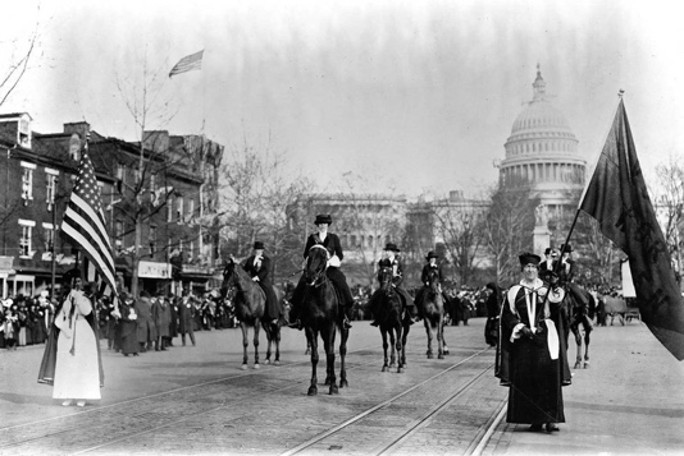
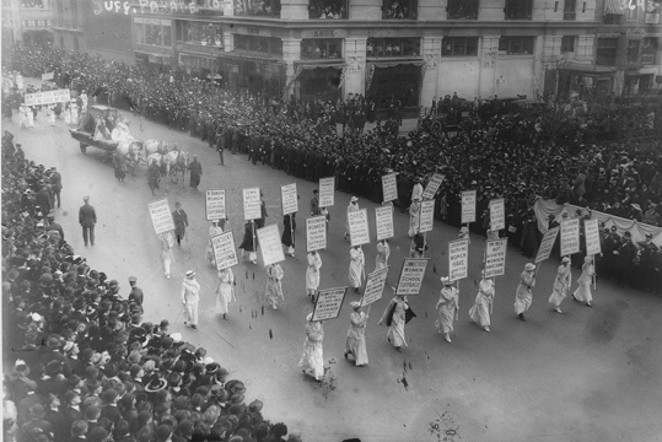
By 1914, the situation took a turn for the worse for mothers and children as the backlash raised its head once again. The first adult psychiatric clinic was directly linked to a court in Chicago. Wives could be involuntarily committed to a mental asylum for simply “defying their husbands.”
The problem of homeless children was visible, and led to another social experiment, the “orphan train movement.” This was a supervised welfare program designed to rescue children and relocate them to families to rural areas. The downside was they were exploited and expected to do farm labor.
Children who were not homeless but were abused in the family were being removed from dangerous families and relocated to other families. A move toward family preservation of the original family, rather than permanently separating them from their parents, began in the early 1900s, along with a shift toward government agencies to supervise foster parents. Foster parents became part of a professional team to provide temporary care while agencies tried to fix their parents through services.
Then World War I began in Europe in 1914, somewhat inexplicably over the assassination of an obscure European Archduke. By 1917, the United States entered the murderous fray, and, as the Carnegie Foundation had predicted, the life of an entire people began to be altered.

As men moved onto the battlefield, women moved into the factories. They inhaled the heady scent of economic freedom, along with 1918 “Spanish flu” pandemic flu droplets which killed 50 to 100 million people worldwide. The war ended that November after 37 million people were killed.
By 1920, over half of Americans had become city dwellers. New immigrants crowded into cities and the air shifted again, clogged with the new smell of factory smoke and the old stench of racism. A new anti-immigrant Ku Klux Klan wave rose up with violent confrontations. At the same time, Jim Crow laws were passed in the south to continue the oppression of black Americans. Lynching continued.

The concept of white male supremacy and entitlement burned with vitriol. Blatant discrimination against anyone else, all of whom were considered less than human, was nearly ubiquitous. However, women and a few more egalitarian men were making headway. Through valiant efforts by temperance societies aimed at eliminating harmful social ills resulting from drunkenness, alcohol manufacture and sales were prohibited in 1919.
Through equally heroic efforts by the suffragists, including 18 months of picketing at the White House and seven months of jail for Alice Paul, women received the right to vote through the Nineteenth Amendment in 1920. There was real progress in protecting women in 1920, as wife-beating became illegal in all states. In 1923, the Equal Rights Amendment was proposed, to guarantee equal legal rights regardless of gender.
This amendment has never been ratified by the United States.
Children too were receiving more protection. By then, most states had moved the age of consent to sexual intercourse up to 16 or 18 years, which protected children. In 1924, in a stirring expression of the personhood of children, the Declaration of the Rights of the Child, was endorsed by the League of Nations General Assembly and later expanded by the United Nations. It was the first human rights document for children approved by an inter-governmental institution and reads in part:
“The child must be given the means requisite for its normal development, both materially and spiritually. The child that is hungry must be fed, the child that is sick must be nursed, the child that is backward must be helped, the delinquent child must be reclaimed, and the orphan and the waif must be sheltered and succored. The child must be the first to receive relief in times of distress. ….”

This declaration has never been ratified by the United States.
There was backlash against all these victories.
Shortly thereafter, the 1929 stock market crash sent the United States and the world into an economic tailspin. The Great Depression began. People starved. The scene was set for massive social disruption.
Oppression continued. Scientists at the U. S. Public Health Services with questionable values began research in 1932 with the Tuskegee Institute. Black men infected with syphilis were left untreated so the medical community could study the disease. It took 40 years for that infamous study to be shut down and for human subject review boards to be mandated.