“Action may not always bring happiness, but there is no happiness without action.”
William James
I want to go into some exquisite detail in this second part of our Activism history. You might ask why, and with good reason. My thought is that maybe it will help other activists move forward without the ingenuousness we had.
My dear roommate from college majored in government and is one of the smartest people I know. If only her brain could have been transplanted into mine. But I could barely stand looking at the covers of her government textbooks. They were the best sleep enhancer possible. I was clearly not the one with the background or skills to be working on this project to change family courts to keep children safe.
On the other hand, if you, the next activist who decides to pick up where we left off, knowing this history in advance might cut out a lot of lost time that we spent going in circles. Or maybe we needed to go in circles for years because we were not ready and the time was not yet ripe. “When the student is ready the teacher will appear.” Tao Te Ching went on to remark, “When the student is truly ready… the teacher will disappear.”
“When the student is ready the teacher will appear. When the student is truly ready… the teacher will disappear.”
I also wanted to show the huge amount of work we’ve done as a coalition to try to keep abused children safe when their parents are separating or divorcing, from the perspective of the California Protective Parents Association (CPPA).
Executive Director Karen Anderson and have tried everything we could think of to improve the court system to better keep children safe from family violence or child sexual abuse. Our fuel was and is prayer and cockeyed optimism, the knowledge that there is a pony somewhere under the pile of manure.
We know dogged persistence is the secret to success. We assume good people will eventually do the right thing and bad actors will soon wither away. We envision a world where children are safe. The picture in my mind of the coming change is from the movie Lion King when the barren hyena-filled wasteland turns into a verdant rich savanna after Simba defeats his evil uncle Scar. We powered on, refusing to be discouraged.


2010 proved to be a heady year.
The good news was that between the passage of the Violence Against Women Act of 1994 under the leadership of then-Senator Joe Biden, and the year 2010 when he became Vice President, the rate of intimate partner violence had declined an astounding 67%. The rate of intimate partner homicides of men decreased (40%) even more than of women (35%). Women were able to now escape without resorting to homicide.
Clearly, federal remedies were potent.
The year started with the arrival of a response from the U.S. Department of Justice to our letter, letting us know that the Office of Violence Against Women had a completed a five year demonstration initiative on Domestic Violence and Child Maltreatment known as the Greenbook Initiative. The project had begun in 2004 and focused on the co-occurrence of domestic violence and child abuse in Grafton County, New Hampshire; El Paso County, Colorado; St. Louis County, Missouri; Lane County, Oregon; San Francisco, California and Santa Clara County, California.
The last two sites were right here in Northern California, practically next door to us. I was amazed. San Francisco had not been a problem for us at all, but Santa Clara was the first California family court Karen Winner had investigated back in 1997 after Kathy Justi had started organizing and demonstrating with mothers and attorneys there. The federal project had begun much earlier, in 1999, the same year California Protective Parents Association was incorporated. The prestigious Reno-based National Council of Juvenile and Family Court Judges (NCJFCJ) had published their recommendations in a report officially titled Effective Intervention in Domestic Violence and Child Maltreatment Cases: Guidelines for Policy and Practice but better known as the Greenbook Project due to the report’s green cover. It carefully documented the intersection of child maltreatment and domestic violence which had a 30-60% overlap.
It carefully documented the intersection of child maltreatment and domestic violence which had a 30-60% overlap.
NCJFCJ determined that courts and organizations must work together to ensure safety for women, children, and families. They recognized that various systems often had separated from each other or misunderstood the relatedness of these issues. The conclusion was that since co-occurrence was frequent, domestic violence agencies and child welfare services needed to work together.
Victims needed to be protected. Batterers needed to be held accountable. Exactly.
Unfortunately for us, the project did not focus on family court which has jurisdiction over divorce and custody. It focused rather on other systems: government-funded child welfare services which worked with dependency courts on child protection, and domestic violence service providers that were private agencies helping domestic violence victims.
We were learning that each silo operated under its own rules and income streams. None of the systems routinely consulted with the other.
The Seventh Battered Mothers Custody Conference (BMCC) titled Now That We Know, WHAT ARE WE DOING ABOUT IT? was held in Albany NY in January 2010, the year New York became the last state to pass a “no fault divorce” bill. Before the conference started, we held a speak out at the NY Capitol, then had a Family Court Reform Coalition (FCRC) meeting of national leaders in the movement to protect battered women and their abused children.
The focus of the conference was on the critical need of the court system to adhere to the established research on domestic violence, abuse and child custody. Barry Goldstein spoke movingly. Angela Shelton gave a wonderful talk. We met attorney Charlie Hoffheimer from Virginia.
Kathleen Russell and Steve Burdo gave a workshop on lobbying at the BMCC. Kathleen and I decided to roll out our dream to educate the White House and Congress on the little known, seriously ignored problems in family court. Our workshop showed the documentary Pray the Devil Back to Hell about Liberian women who had a crazy dream and stopped a civil war in its tracks. They wore white t-shirts.
We announced our upcoming Mother’s Day event in Washington DC and handed out white t-shirts with big letters on the front: “Mothers of Lost Children.” We asked those who took a shirt to attend the upcoming D.C. march.
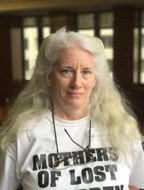
That was when I found out there had been a previous Mothers’ Day demonstration at the White House 18 years before, in 1992. We were the second wave of mothers coming to Washington DC.
Then we hurried back to California to get ready for the next Davis conference.
Another murder-suicide met us. In Yucca Valley CA a young woman Katie Tagle, who had left her boyfriend Stephen Garcia in August 2009, was having to share custody of their nine-month-old baby Wyatt with him. In January, Stephen emailed her a story about them. The ending of the story was that he murdered their infant for revenge because Katie had left him. Despite the email and subsequent death threat texts from Stephen’s against little Wyatt, evidence of domestic violence and a threat against Katie, San Bernardino Judge Robert Lemkau refused to grant her an emergency restraining order.

“My supposition, ma’am, is that you’re lying,” said Judge Lemkau.
Ten days later, on January 31, Stephen shot and killed the baby, then killed himself.
Thanks to picketing led by Jeff Belmont and other Southern CA activists, Judge Lemkau was beaten in the next election and stepped down. But that was pretty much it for the judge’s penalty, whom we considered an accomplice to murder.