“The resolution to avoid an evil is seldom framed till the evil is so far advanced as to make avoidance impossible.”
Thomas Hardy
Congresswoman Jackson Lee let the Congressional Resolution drop. We never knew why, but I figured it was about fathers’ rights pressures. Joan Meier, the wind under our wings, introduced us to lobbyists Greg Laughlin and Craig Saperstein at Pillsbury Law Firm, who began working pro bono for the Cause. That made all the difference in the world. Greg was a former Congressman from Texas and knew everyone. Everyone liked him. We realized that personal relationships really were key, just as for resilience.


Also, I don’t think Congress members were exactly used to hoards of beautiful, devastated mothers in white t-shirts walking the halls of Congress. Our team was pretty striking. We showed up year after year. We were always polite. We always told histories that made staff members weep.
But it was hard not to run screaming down those hallowed halls, tearing our hair, knowing the horrifying reality of the outcomes of placing children at risk. On July 27, 2016, Jacqueline Franchetti was ordered by Nassau County, New York Judge Danielle Peterson to send her two-year old daughter Kyra on a week-long unsupervised visit with her violent father Roy Eugene Rumsey in Virginia, despite his threats, abuse and suicidality.
A forensic evaluator recommended joint custody of the toddler, and the child welfare services found only a low risk. Nowhere was a lethality assessment mentioned in the news reports. A toddler was found dead in a Fairfax Virginia burning house, later identified as Kyra. During the visit, the father had shot Kyra twice in the back while she was asleep, then set the house on fire and shot himself.
After falling to her knees with pain, Jacqueline Franchetti got back up and became an activist, like Ana Estevez and so many others. She began the Kyra Franchetti Foundation and Kyra’s Champions and embarked on her life’s work to reform laws to ensure child safety.

On September 9, 2016, H. Con. Res. 150 was introduced by Congressman Ted Poe, a Republican from Texas and cofounder of the Victims’ Right Caucus, and New York Congresswoman, a Democrat. The purpose was clear. “Expressing the sense of Congress that child safety is the first priority of custody and visitation adjudication and that state courts should improve adjudications of custody where family violence is alleged.”

Now it was my turn for tears. The gestation had been years, but here was tangible proof that we were being taken seriously, that some people in Congress truly cared. It may have been non-binding, but Congressional Resolutions gave guidance to states, and that was exactly what we needed. Child safety in family court was finally on the federal radar screen.
We held another Congressional briefing from 12:30 to 2:00 pm on September 13, 2016 at the Capitol Visitor Center, titled Protecting Child Safety in Family Courts.
It was sponsored by Domestic Violence Legal Empowerment and Appeals Project (DV LEAP), Advocates for Child Empowerment and Safety (ACES), Center for Judicial Excellence (CJE) and National Partnership to End Interpersonal Violence (NPEIV). Kathleen moderated. We invited Congressman Poe, former Congressman Greg Laughlin, Craig Saperstein, Joan Meier, and Viola Vaughan-Eden to speak, along with mothers and children who were affected negatively by family courts.
“‘Protecting our children is one of the most important things we can do for society,’ said Poe in a press statement announcing the measure. ‘Courts should resolve all claims of abuse independently, before looking at any other factors in deciding custody or visitation. An independent and rigorous investigation into claims of abuse, coupled with heightened evidentiary standards, will help courts prevent the endangerment of any child.’”
We even got press coverage in ProPublica that day. The article was titled Call in Congress for Family Court Reform Domestic Violence. Physician Amy Castillo’s 2008 case was highlighted. Her former husband Mark Castillo, a gym teacher, had drowned their three children Anthony age 6, Austin age 4 and Athena age 2 in a bathtub of a Baltimore hotel room. Montgomery County District Court Circuit Judge Joseph Dugan had granted her a temporary protective order but rejected a permanent order and ignored her pleas for protection. After the murders, Mark Castillo had swallowed 100 Motrin tablets, stabbed himself in the neck with a steak knife, woke up 19 hours later, realized that his suicide attempt was a failure, and finally pled guilty to his crimes.

Leora Rosen PhD had put together a handout of an analysis of data from 2005 National Institute of Justice-funded studies of custody and visitation awards. The fathers were all substantiated abusers. 34-51% of children were placed in unsafe visitation or full custody of those fathers.
The fathers were all substantiated abusers. 34-51% of children were placed in unsafe visitation or full custody
The next day, September 14, we had our biannual march around the White House. In between events, we met with Congress members to urge them to support and co-sponsor the Congressional Resolution sponsored by Congressmembers Ted Poe and Carolyn Maloney. We took a support letter endorsed by 26 organizations around to every office. We were dogged.
We did not know at the time that our champion Congressman Poe had been diagnosed with leukemia in July and would need to retire the following year.
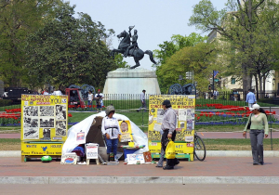
We learned that year that the tiny woman named Concepcion Picciotto, who lived in an equally tiny tent in front of the White House near Lafayette Park where we gathered each year, had died on January 25, 2016. She too had lost her daughter and her home during a divorce in the early 1970s. She too had come to Washington to ask for help from her Congress member and there she stayed, until her death. Kathy Lee had given her a white Mothers of Lost Children t-shirt. Her hand painted signs protested nuclear bombing and asked for peace. Her life was a testament to persistence, endurance and righteousness.
Commission to Eliminate Child Abuse and Neglect Fatalities, created by HR 6655/Senate 3705 the Protect Our Kids Act in 2014, was chaired by Daniel Saunders, a proponent for safe children, and balanced out by a member of the Commission Wade Horne, an alleged proponent for fathers’ rights, unveiled their report in 2016. It was titled “Within Our Reach: A National Strategy to Eliminate Child Abuse and Neglect Fatalities.”
- Every day, four to eight children in the United States died from abuse or neglect at the hands of their parents or caretakers, mostly infants or toddlers. No one knew the exact number, and there had been little progress in preventing these tragic deaths.
- Only one practice with research evidence showed a reduction in fatalities: Nurse-Family Partnership.
- The Commission strongly endorsed funding for prevention and early intervention services, especially multi-disciplinary support for parents with drug addictions, mental illnesses, cognitive disabilities, previous criminal histories, domestic violence, or those in unsafe, crime-ridden communities, to mitigate the need for late-end, crisis-oriented, intrusive, and expensive interventions.
- A retrospective review of the past five years of child abuse and neglect fatalities would help identify family and systemic circumstances that led to child maltreatment deaths.
- Accountability, sharing real time data electronically and holding joint Congressional hearings on child safety were recommended.
The Resolution for child safety began its journey through Congress, which turned out to be much longer, with more twists and turns, than we had imagined. The plan was that after it was passed, we would use the federal guidance to make changes to state laws.
A week after the Resolution was introduced, a Minnesota mother Sandra Grazzini-Rucki was sentenced to jail for hiding her two teenage daughters who had repeatedly accused their father of abuse. The two people who kept the teens on their horse ranch, Doug and Gina Dahlen, were also sentenced.
We began looking for more allies. We went to the NPEIV Think Tank and met with the Policy Action team, who were already great supporters. Our strong supporter civil rights attorney Pat Barry in Los Angeles who argued the first sexual harassment case in the US Supreme Court in 1986 (Meritor Savings Bank v Vinson) was disbarred for her zealous advocacy of protective mothers.