”There are no rules or formulas for success. … It’s quite literally, ‘Let’s try lots of this stuff and see how it works’”
Anita Roddick
A bit more history is helpful.
A baby girl named Mary Ellen Wilson was born in 1864 in the aptly named Hell’s Kitchen, New York. Her father was killed in the Civil War. Her mother took a job and boarded her infant with a woman who, when payments stopped, gave Mary Ellen to the New York Department of Charities and told the mother that her baby had died. The child was then illegally placed with a couple, her foster father also died, and her foster mother remarried. Things got worse.
A kind neighbor told missionary Etta Wheeler that little Mary Ellen was being badly abused. As authorities would not act, she turned to Henry Bergh who had founded the American Society for the Prevention of Cruelty to Animals in 1866. He pulled some strings and removed the child from the violent foster home.
In 1874 when Mary Ellen was 10, she testified to the New York Supreme Court that she was beaten every day with a two-foot braided rawhide horse whip. She said, “I never dared to speak to anybody, because if I did, I would get whipped.” The foster mother was convicted of assault and battery by a jury. Mary Ellen was placed in a juvenile home, essentially a reform school, but Etta Wheeler mercifully rescued her again. The child was raised by her family who gently taught her how to be a child.
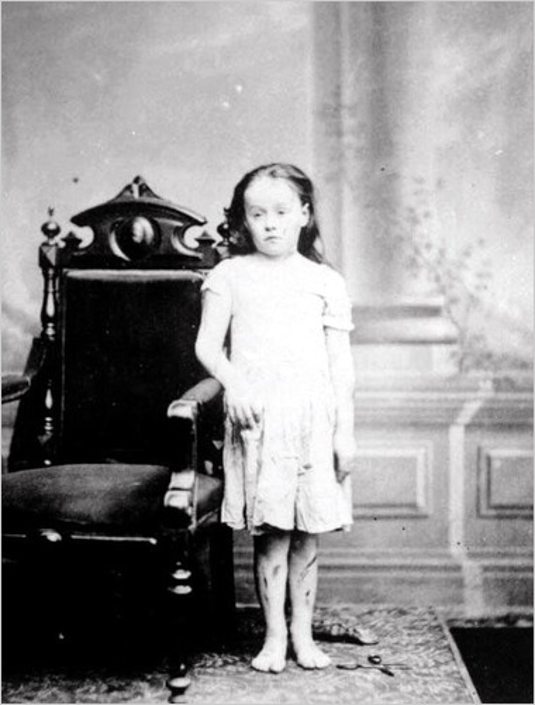
That year, the first ever New York Society for the Prevention of Cruelty to Children began. At first, children were taken out of abusive homes by the new Society. Lawsuits followed. Parents were found to have a constitutional liberty interest to raise their children.
I wasn’t sure if foster care was any better today than children’s problematic biological families, given Mary Ellen’s heinous foster care experience. I searched around the internet and found that most children are removed from their homes because of neglect, not for being beaten with or without a rawhide whip, or sexually assaulted. Half were black and brown children. Most were under a year old. Drug addiction led to a third of removals.
It wasn’t long before it became clear how truly caught between a rock and a hard place these little ones are. Shocking studies showed children in foster care are far more likely to be abused than children in the care of their biological parents.
According to Georgia Senator Nancy Schaefer. “The National Center on Child Abuse and Neglect in 1998 reported that six times as many children died in foster care than in the general public and that once removed to official ‘safety,’ children were far more likely to suffer abuse, including sexual molestation, than in the general population.”
Foster children are not only traumatized by being taken away from their families but are incredibly vulnerable. Foster care was flat out dangerous. One hair-raising study found children in foster care are four times more likely to be sexually abused, and in group homes (small non-family institutions with several children) are a staggering 28 times more likely to be abused.
One hair-raising study found children in foster care are four times more likely to be sexually abused.
More than half of child sex trafficking victims are from foster care. Where children are, you will find pedophiles. Predator foster care families find the children easy pickings. They are handed their victims, plus are paid for their “care.” One woman reported she was ritually abused and trafficked by three different foster families.
Yet at the same time, many of the over 300 thousand foster children have been rescued from terrible situations each year. The majority of subsequent maltreatment happens during visits or trial reunification with birth parents. Reunification does not usually go well. One study showed that 56.9% of former foster children agreed that “All in all I was lucky to be placed in the foster care system”. Only 17.6% disagreed.
Most children have to wait two or more years for adoption, especially older and black children, and up to a third of adoptions fail. Being moved around to a series of different foster families is a disaster. And social workers turn over frequently as they burn out and move along.
The volunteer Court Appointed Special Advocate (CASA) program helps by giving children an ongoing mentor and gives juvenile courts a better understanding about their well-being.

But we were hearing many complaints about the volunteer Guardian ad Litem program. Like the attorneys for the children, it seemed GALs increasingly aligned with batterers.
What happens when foster children grow up? Overall, studies and other research shows they have below average education levels, higher arrest rate, more teen pregnancies. Group homes lead to even poorer outcomes, although those children might have had more problems to begin with and are almost guaranteed to be abused in care.
Yet, a majority of former foster children manage to wobble through adult life. A stable foster care or adoption, and a steady mentor after they age out seem to improve outcomes.
There simply had to be a better way than children being abused by the tiger they know versus the tiger they don’t know. The federal government seemed to be trying to get it right, but there are no perfect answers. Clearly, there needs to be better screening of foster caregivers, and prosecution for crimes against children in state care. This is “state-created danger.”
Intensive home visitation, parent training and other prevention programs appear to be the best option to keep children safe in their homes. It also saves money but does not feed the burgeoning foster apparatus.
I was glad not to be in charge of child welfare services. My hair would be on fire all the time.
The other silo, family court, is also known as divorce or matrimonial court. It focuses on marriage dissolution, property division, custody and support. It is a state bureaucracy. There is no federal agency directly involved, although federal funds similarly flow to the state which sends them on to the local court system.
In California, the family courts are presided over by elected state judges and subordinate judicial officers called “commissioners.” Instead of social workers, this court relies heavily on court-employed mediators and, in California, “child custody recommending counselors,” along with problematic expensive private court-appointed “child custody evaluators.” There are no attorneys provided pro bono, unlike juvenile court.
When a custody dispute arises, protective mothers enter a truly upside-down strange world that betrays children who blow the whistle on violent or incestuous fathers. In California, family courts are open and can be observed. There is an appeals process, dysfunctional as it may be.
The notable lack of a record of a hearing, unless you pay handsomely for a court reporter and even more for the transcripts, has been egregious. The inequity was too much for the California Supreme Court, which finally ruled in 2018 (Jameson v Desta) that poor litigants too needed to have an official record made of their hearing.
Middle class litigants are out of luck. Again, oversight is minimal. The problem is enforcing it. We were learning these subtleties through trial and error, mostly error.
By then we did not have much trust in family court, juvenile court, child welfare services or law enforcement. It seemed to be a dirty system unless you happened to luck into a good person in the middle of the mess. The mournful song I Dreamed a Dream from Les Miserables said it well. We could hear the tigers roaring at night, “their voices soft as thunder.”

2005 was a good year for research on custody, domestic violence and sexual abuse.
A 2005 study Child Custody and Visitation Decisions When the Father Has Perpetrated Violence Against the Mother by Allison Morrill, et. al. found that over half of children were in unsafe placements. The authors concluded that the quality of domestic violence training for professionals was more important than the quantity.
Another study Children in the Crossfire: Child Custody Determinations Among Couples With a History of Intimate Partner Violence by Mary Kernic, et. al. found that where domestic violence by the father was known to the court, there was a lack of strong protection for the victims. That we knew well.
A third study False allegations of abuse and neglect when parents separate Nico Trocme and Nicholas Bala found false reports of child sexual abuse were small, consistent with earlier research. Only 5.4% were determined to be intentionally false and none of those originated from the children. Yet evaluators, mediators and judicial officers were casually invalidating 90% or more of the allegations even after children reported sexual abuse to therapists, social workers, law enforcement officers, attorneys, teachers, friends, relatives, neighbors. Clearly, opinion and bias were at odds with science.
Only 5.4% (of child sexual abuse reports) were determined to be intentionally false and none of those originated from the children.
Two studies showed treatment did not impact recidivism for sex offenders. And those were just the offenders who got caught after release:
- Evaluating Community Sex Offender Treatment Programs: a 12-Year Follow-Up of 724 Offenders by Harrison Bloom in 2004, and
- Recidivism Rates of Sexual Offenders up to 7 years Later: Does Treatment Matter? By Kristen Zgoba and. Leonore Simon in 2005
Children are not safe alone with sex offenders. Sex addiction is a real thing. This was no surprise to us, but it was nice to have the data to back up our instincts.
Those little hairs on the back of our necks stood up even higher and straighter.