“Life is full of ups and downs, the only way to make the journey worthwhile is if you enjoy the good and learn from the bad.”
Natasha Potter
We had no idea how to do impact litigation or put funding restrictions into federal law, as recommended by the FCRC team as the top three ideas, but the Congressional Resolution idea seemed feasible for mothers to accomplish.
We suddenly felt something new. There was a bit of wind under our wings.
“What next?”
“Dunno. Let’s keep trying things.”
The Center for Judicial Excellence, Child Abuse Solutions, Inc, Commission on the Status of Women, Legislative Coalition to Prevent Child Abuse and CA Protective Parents Association met with Judicial Council Tracy Kenney and Donna Hirshkowitz and Assembly General Counsel Fredericka McGee again on February 25.
We asked how many evaluations were done per year. Just a few in each county, they said, with varied payment methods. Some courts contract out all cases. That year, Orange County had done 275 Family Code 3118 investigations using in-house staff, which pleasantly surprised us.
That year, Orange County had done 275 Family Code 3118 investigations using in-house staff, which pleasantly surprised us.
But again, they flatly turned down the idea of a standardized template to implement the law, Family Code section 3118. It was so mysterious.
Meera, a Judicial Council-approved trainer, explained that she attended another approved training for evaluators where only 30 minutes of the 40 hours required by the Rule of Court were on child sexual abuse.
Training on child sex abuse was the whole purpose of the law. They said the Judicial Council approved, but did not oversee or police the training, and retorted that there was no set number of hours for child sexual abuse training in the statute.
They threw us a bone, saying they would look into a possible rule of court to specify hours for child sexual abuse training.
Nothing happened.
They did acknowledge that juvenile court trumps family court, meaning that if juvenile court found that a child had been abused, that court took jurisdiction of the case. We again requested a policy statement by Judicial Council for the physical and sexual safety of children to be the priority in judicial determinations.
That went nowhere.
We asked about Elkins Family Law Task Force’s lack of a women’s focus group and open public hearings. The response came a short two days later, when Assembly Judiciary Committee Chairman Mike Feuer released the language of AB 939. It regulated a variety of family law procedures and had been prepared in advance, so our input to Elkins had been mere window dressing. Spitting into the wind.
The bill did not address the issue of children being placed at risk at all. We smelled another rat.
Elkins Family Law Task Force was where the term “recommending child custody counseling” appears to have been born. This was a heavy-handed, absurd response to our comments that parents were forced into obligatory mediation and would find to their shock that mediators could, and in most California counties did, make recommendations to the judge if the parents could not agree. It was a bait and switch.

Mediation is supposed to be a method of dispute resolution between parties that is facilitated by a neutral mediator. If the mediator is making recommendations that are then followed by the judge, the parents are, in fact, appearing before the de facto decision-maker without realizing it. They are blindsided.
The judges read the custody recommendations before the parents came to court, and are ready with their judicial decision, based on staff recommendation. Witness testimony becomes useless noise, just like our input to the Task Force.
By changing the title from “mediator” to “child custody recommending counselor (CCRC),” the parents at least had knowledge that what they were doing was not mediation. This clever end-run around the original intent of the California Supreme Court in the Elkins case, to ensure witnesses could testify in family court hearings rather than just submit documents, was completely undermined. The custody decision is already made by the “child custody recommending counselor.”
“The fix was already in,” as Jean Travis had said, a decade before.
Kathleen and I met with Judicial Council and Assemblyman Mike Feuer’s chief of staff, who smoothly assured us that the proposed AB 939 language was just a placeholder in the effort to comply with the Elkins Family Law Task Force recommendations. Judges Jerilyn Borack from Sacramento and Judge Mark Juhas from Los Angeles were on the Task Force. I wrote a letter objecting to the case management language in the bill on March 4.
I wrote a letter of opposition to AB 939, urging that problematic cases be studied, and domestic violence and child abuse be addressed. Our point of objecting to mediation had been that cases of violence and sex abuse should not be mediated at all and should be treated as criminal acts with a proper investigation to gather facts and evidence to suggest danger or lethality, from which children should be protected.
Our point of objecting to mediation had been that cases of violence and sex abuse should not be mediated at all and should be treated as criminal acts with a proper investigation
There was another Elkins Family Law Task Force meeting on April 4, dangling the possibility of change in front of us like a laser beam in front of a cat. I kept falling for the shimmering mirage.
The misinterpretation of our concern for children’s safety by implementing “recommending child custody counselors,” rather than investigating crimes in these cases, seemed deliberate. The oily stench of gaslighting hung in the air.
We were continually stunned, knowing that abused mothers and children would be ultimately harmed by making staff into de facto decision-makers, rather than using proper court processes with sworn witness testimony.
At the same time, unbeknownst to us, Assemblyman Feuer had also passed a good bill, AB 590 creating the Sargent Shriver Civil Counsel Act to fund pilot projects for legal representation to low-income litigants on critical legal issues affecting basic human needs, including landlord/tenant issues and custody. This was helpful in the few counties that elected to have attorneys for low-income family court litigants, and we were grateful for the attempt to help.
There were shining examples of good Legislators. AB 2960 (La Malfa) added child sexual abuse to Family Code section 3064(b). The author was forced to water the bill down by adding that the abuse had to be immediate or part of a pattern. One past child rape was not enough.
Family Code section 3064(b)….
- “Immediate harm to the child” includes, but is not limited to, either of the following:
- (A) Having a parent who has committed acts of domestic violence, if the court determines that the acts of domestic violence are of recent origin or are part of a demonstrated and continuing pattern of acts of domestic violence.
- (B) Sexual abuse of the child, if the court determines that the acts of sexual abuse are of recent origin or are part of a demonstrated and continuing pattern of acts of sexual abuse.
It did not, however, stop the carnage in family courts.
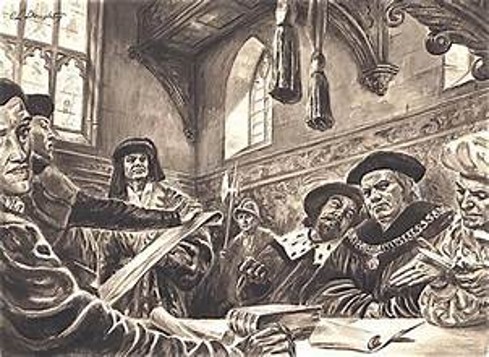
Professor Geraldine Stahly had called family court hearings “star chamber proceedings.” I had to look that phrase up. It means a judicial action that so grossly violates standards of ‘due process’ fairness that there is no fair hearing. It comes from The Star Chamber, a room in the 14th and 15th English royal palace that had stars painted on the ceiling where frightening, arbitrary decisions and gruesome punishments were meted out by the powerful against the powerless.
The games were much more devious and brutal than I had previously understood.