“The only cure for grief is action.”
G. H. Lewis
My heart was pounding so hard it somehow got to my throat, then rushed up into my ears. I couldn’t hear for the jack hammer inside. The fear spread into a full crackling aura around my body, radiating out, felt by everyone in its orbit, a tangible presence that emanated further and further like pond ripples. My arms were clutched around my torso, which was trembling. To say I was scared would be an understatement.
My abusers warned me repeatedly that I’d die if I told. And I was about to tell.
Pretending, I walked slowly and steadily across the black parking lot asphalt toward a big building on campus. A kind friend Rob was with me, matching me, step for step. He understood I needed support, but didn’t think there was much chance of actual danger. The winter sun hid itself. The campus lights went on, a pale comfort. We reached the U. C. Davis Memorial Center safely.
“God, are you there?” I didn’t dare ask out loud.
Would I be shot? Maybe poisoned? Have a heart attack? The talk went well. Another survivor, a superlative therapist and I were there as part of a Rape Prevention series, to speak about unspeakable things. The audience was aghast. Silent. Then came the applause that didn’t stop for a long time.
The audience was aghast. Silent. Then came the applause that didn’t stop for a long time.
It was February 1991. I’d started my life of public truth-telling that night, both to tell my story in hopes somebody somewhere would do something to stop the madness, but also for protection, as a detective had emphatically advised. “They’re less likely to kill people who are very public.”
The foundation for activism has been laid over the previous decades. Our little incest survivors support group, which began in 1988, started to look for ways to stop the incest scourge. We had gone through a great deal of healing together over the years and felt it was time. Speaking out about the taboo subject of child sex abuse seemed the logical next step.
We gave over 20 presentations to various agencies and organizations between 1990 and 1994, including television and newspaper interviews and articles.
At a 1994 San Francisco conference titled Breaking the Silence, Breaking the Cycle, playwright Libbe Ha Levy gave a stirring speech.
Her play about child sex abuse, Shattered Secrets, had been presented in Davis. Striding across the stage like a general, she urged survivors to get busy and let the world know that incest was prevalent and destructive. The professionals were busy helping us heal and were not tasked with broadcasting the problem. That was up to us.
Striding across the stage like a general, (playwright Libbe Ha Levy) urged survivors to get busy and let the world know that incest was prevalent and destructive.
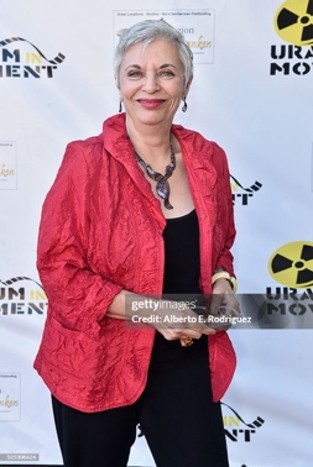
“Hey. We can do that.”
That very evening on the drive home, the Incest Survivors Speakers Bureau was formed. Within a year, we had a mission statement, a Post Office box and a brochure, and later a website. Libbe said ours was the first of its kind, and therefore a pioneering effort. We were basically the first generation of survivors to heal and were leading the way. Prior to this time, incest was hidden and festering. We buckled down to the job of exposing it to sunshine.
“Hello. I’m from Incest Survivors Speakers Bureau. Would you like a luncheon speaker on child sex abuse? We’re available.”
The local Kiwanis Club receptionist was on the other end of the line. There was a long silence.
“Um, we’ll have to get back to you on that.”
Undeterred, we decided on a different tact. We would do it ourselves. We had no idea how to pull off such an undertaking, but we did. We found a nice venue at the Davis Senior Center and put on the First Annual Child Sexual Abuse Awareness Conference on January 28, 1995, titled Once Upon a Time. Dave Rosenberg, Davis mayor, opened the conference and professionals spoke on sexual and ritual abuse.
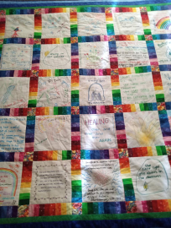
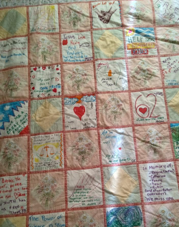
The response to our amateur event was incredible. Survivors told their stories. Professionals spoke at no cost. People came to hear. We baked cookies and got donations of bottled water. The local paper ran stories. We forgot to make programs. Artist Rose Ginsberg created a website and kept track of the conferences. Linda Day made a quilt from squares drawn by survivors. Over the years, more quilts were created from squares of linen with depictions of atrocities called into life through eloquent words and hand-crafted pictures of pain and triumph.
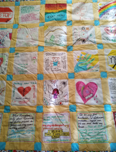
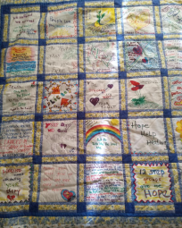
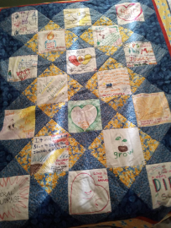
There was an associated seminar, a talk at U.C. Davis on Physicians Treating Sexual Abuse Survivors with Dr. Shannon Smith. Ritual abuse survivors told our histories, which stunned the medical students. One survivor told of having to drop out of medical school when her gruesome memories hit.
Ritual abuse is defined as “Repeated, extreme, sadistic abuse, especially of children, within a group setting. The group’s ideology is used to justify the abuse, and the abuse is used to teach the group’s ideology. The activities are kept secret from society at large, as they violate norms and laws.” It often includes elements of worship, murder, cannibalism and rape. There is a concerted effort to dismiss, mock and silence survivors who speak out, due to the capital crimes being committed, so it is not as well-known a form of child abuse. In 1968, the movie Rosemary’s Baby introduced the subject obliquely, but most people had never heard of it.
We kept going.
The next year we expanded, holding the Second Annual Child Sexual Abuse Awareness Conference on February 10, 1996, which we called The Body Remembers in Davis with Shannon Smith MD and Cathy Neuhauser PhD. Laurie Jones JD, MBA began as our moderator. There was an inspiring survivor panel and a film True Not True, and choral presentation by the Sacramento Women’s Chorus.
A week later in nearby Woodland, we held another event, It Takes a Whole Village to Raise a Child. Curious as to how system people worked with child sex abuse, we invited the sheriff, the police, the District Attorney and child welfare services to present together, along with the mayor of Woodland Gary Sandy.
Survivors who successfully prosecuted their perpetrators spoke. One of the agency representatives said it was the first time they had presented together in the same room. We all learned from it. We even had programs to hand out this time.
One of the agency representatives said it was the first time they had presented together in the same room.
Protective mothers crept forward also, but more tentatively. It was much harder, if not impossible, to heal from being prohibited from keeping your child safe from incest by court order. The protective mothers could barely believe what had happened to them. There was no “post” to the traumatic stress endured by the mothers. It was all happening in real time.
We were impelled forward.
In the mid-1990’s several mothers had started meeting in the pretty Davis Central Park to beg God to intervene. We asked Him to keep children from being taken from safe mothers and given to violent, incestuous fathers. We sat on wooden benches by the Hattie Weber Museum, even when it was raining when we held up big umbrellas over our heads, to pray for the children who lived with abusers and ask for them back. Even if the answer from the Almighty was “no,” it seemed to help our shredded souls.
It was a powerful experience. One woman from our prayer band said that the day after joining us she felt like a completely different person. She was able to think clearly and feel positive for the first time in forever. We called ourselves Mothers of Lost Children. It was patterned conceptually after the Madres de la Plaza de Mayo, women who met to demonstrate and pray in front of the Argentine presidential palace, the Casa Rosada in Buenos Aires.
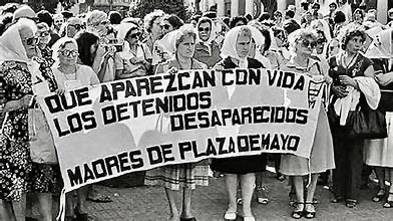
Their adult children were being “disappeared” by the government led by a brutal military dictatorship during the dirty war, and were imprisoned, beaten, raped, and usually killed. The mothers defied the state terrorism and began marching in 1977 at the Plaza de Mayo. They were first responders to the junta’s human rights violations.
American children were being “disappeared” just as systematically by our governmental threats and actions. Minor children were being taken from safe mothers by family court when they reported abuse. It was a dirty war against children. They were imprisoned with abusers in home-based prisoner-of-war camps that were even worse than our government-run prisons. They were beaten, raped, and sometimes killed.
These were human rights violations, as brutal as in any repressive government at any time in history. It seemed impossible to believe it was happening in the United States.
Two young girls made explicit disclosures of molestation by their father to their mother, their therapists and law enforcement. Despite corroborative medical evidence and symptoms of nightmares, excessive fears, sexualized behavior, depression, dissociation, anger, physical pains, headaches, stomach aches, constipation, encopresis and receipt of California Victims of Crime funding for therapy due to the crimes committed against them, they were taken from their mother at ages four and seven and given to their father.
Their mother was accused of Parental Alienation Syndrome are placed on supervised visits. After spending $250,000 and declaring bankruptcy, their mother was forced to represent herself against the father’s attorney and the children’s attorney who functioned as a de facto attorney for the father.
The children never returned.
Was our government an ally in the abusers’ vicious war against children? The difference with Argentina was primarily a matter of age. American children were very young.