“Violators cannot live with the truth: survivors cannot live without it.”
Chrystine Oksana
The next day of the conference, the topic was Ritual Abuse in the 21st Century based on Dr. Noblitt and Pam Perskin Noblitts’ book Ritual Abuse in the 21st Century: Psychological, Forensic, Social and Political Considerations. They presented evidence of ritual abuse, data from the Extreme Abuse Survey, how ritual abuse happens, the fierce efforts to discredit ritual abuse allegations, the devastation left by this kind of abuse and how survivors manage to heal.
A panel of ritual abuse survivors gave a human face to the academic description and discussed paths to recovery. The year before, one of the survivor panelists Anne Davis had published Hell Minus One: My Story of Deliverance from Satanic Ritual Abuse and My Journey to Freedom. Both her mother and step-father had confessed to being perpetrators of ritual abuse. It was an extraordinary experience for survivors to speak on such a taboo topic and be validated by a respected professor, strong research and an admission by offenders.

Both her mother and step-father had confessed to being perpetrators of ritual abuse.
Back in the Legislature, at an Assembly Judiciary Committee hearing on AB 612 to eliminate the used of junk science on April 28, actress and protective mother Nancy Lee Grahn stared right at Chairman Mike Feuer and said she was from his district, represented PROTECT and told her family court story. Marivic Mabanag testified. The chair came up with a new amendment which watered the bill down. It miraculously got out of committee, despite being dead on arrival.
Camille Cooper from PROTECT who was also an actress on General Hospital confronted Assemblyman Feuer in the hallway and said they would vote him out of office.
Center for Judicial Excellence, with the help of CA Protective Parents Association, brought a potent group of advocates, protective parents and children to speak directly with Assemblywoman Fiona Ma. She was stunned at their testimony and quickly moved forward with AB 1050 for teenagers who were fourteen or older to have the right to speak directly to judges if they wished.
On April 29, 2009, Kathleen Russell displayed the photos of mothers and children at the Crime Victims United Legislative Day and several other venues in the spring.
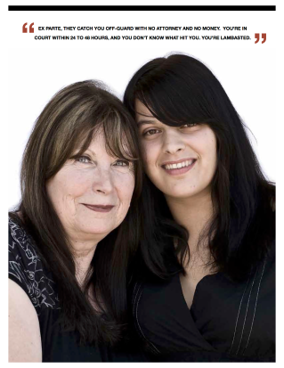
We went again to the Elkins Family Law Task Force on May 13, where the predetermined outcome was rolled out. Judges would become case managers with no more stipulations. Due process flew out the window. Committee counsel Drew Liebert asked if I was ok with that. I said no, judges would have unbridled power.
But the big boys had it all in hand and rolled right over us like we were bugs on concrete.
On May 28, 2009, the California Assembly Select Committee on Domestic Violence held an informational hearing on allegations that family courts are placing children with batterers. It was a dream we had for 8 years.
Chairwoman Fiona Ma (D-San Francisco) heard testimony that family courts did not listen to children’s testimony nor to their wishes. Assemblyman Jim Beall (D-San Jose) stated, “The family courts are broken and need to be fixed.” He presented a medal to a Courageous Kid who testified.
AB 1050 the bill to give children a voice in family court was already moving along, although it hit some snags that year and became a two-year bill. Assemblywoman Ma kept going. It finally became law in August 2010.
Family Code section 3042 states in part:
FC section 3042 (a) If a child is of sufficient age and capacity to reason so as to form an intelligent preference as to custody or visitation, the court shall consider, and give due weight to, the wishes of the child in making an order granting or modifying custody or visitation.
We later found that some judges were forcing the child to testify in open court in front of their parents, rather than in chambers directly to the judge. How cruel. That was not what we had imagined would happen. Mostly, the new law didn’t seem to have made much difference in the custody outcomes. One domestic violence court judge told me bluntly that he never spoke with the children who were the focus of the domestic violence hearing.
We wrote letters and gathered support during May for the Joint Legislative Audit Request which finally went through, thanks to the skill of Senator Leno and pressure by Kathleen Russell. Maybe it was not as threatening to the overall status quo, but it did call for an audit of Sacramento and Marin courts, which was a first. Appellate attorney Tony Tanke was amazed, which was quite a compliment.
Center for Judicial Excellence held an event on June 7 on Family Court Crisis: A Closer Look at Problems & Solutions in Sonoma County. The documentary Family Court Crisis: Our Children at Risk was shown and the Family Court Crisis: Surviving a Broken System Photo Exhibit was displayed. On June 11, Supervisor Gail Steele held another event in Alameda County that included actress Nancy Lee Grahn, Meera Fox, Nancy Lemon, BAWAR, Robin Yeamans and others.
The Safe Child Coalition became viable as a national group. Our various organizations and advocates began showing up and being heard across the country.
The National Institute of Justice (NIJ) published Practical Implications of Current Domestic Violence Research: for Law Enforcement, Prosecutors and Judges in 2009, mostly focused on law enforcement and criminal prosecution. It was based on a massive amount of research and was easy to read and understand.
The basics were straight from kindergarten etiquette. We learned if somebody hits you, they get in trouble. If they hit you again, they get into worse trouble. That’s how people learn.
PROBLEM
Domestic violence comprises the largest category of police reports.
- Only a small percentage of the violence was reported, usually after multiple incidents.
- Violence was mostly committed by males with prior records for violence/other crimes.
- Abusers often have multiple victims and have a high likelihood of quickly re-abusing.
- The default presumption: the defendant is likely to reoffend until proven otherwise.
- Substance abuse (but not mental illness) is correlated with domestic violence offenders.
- Victim perception and basic actuarial data are about the same as using risk instruments.
- Predictive risk factors for re-assault:
- Victim’s perception and fears of re-assault.
- Abuser fled the scene of domestic violence.
- Abuser is unemployed, economically disadvantaged, in a disadvantaged neighborhood.
- Firearms are in the household (increased risk of serious injury/homicide).
- Abuser is not the father of child/ren in the household.
- Women who sought medical treatment from domestic violence usually had abusers with substance abuse, intermittent employment/recent unemployment, and less than a high school education.
- Lethality markers that multiply the odds of homicide are:
- Threats to kill (14.9 times more likely to kill).
- Prior attempts to strangle (9.9 times more likely to kill).
- Forced sex (7.6 times more likely to kill).
- Escalating severity of physical violence over time (5.2 times more likely to kill).
- Control over the victim’s daily activities (5.1 times more likely to kill).
- Male abusers who are not fathers of the children in the household.
- Male abusers who threatened their partners with, or used, a knife or gun.
- Male abuser when both partners were drunk.
- Male abuser in relationships with short courtships.